When one collects fossils like I do, it pays to know what you are looking at. It helps one not get ripped off.
Here’s a really good example of this notion.
A few years back, I was browsing a certain website for fossils (because that’s what I do in my spare time when I’m not writing). I found one for about fifty bucks. It was listed as ‘small baby mammoth jaw.’ Not going to lie, something looked off about the piece, though I chalked it up at the time to there being only one rather crumby picture of the item. Still, fifty isn’t bad for mammoth/mastodon material, so I bought it.
A few days later, a box comes. A big box. Now, the ‘baby mammoth jaw’ was the only thing I had outstanding at the time, so I knew this had to be it. Maybe the seller just over-packed…some of them do that out of an abundance of caution. It’s also very heavy, heavier than I would have expected from a ‘small’ fossil. So, I open up the box. A few things were noted immediately.
1st: This thing was not ‘small.’ It was dang near a foot long and about ten pounds.
2nd: It was in absolutely atrocious condition. Stabilization with a load of PaleoBond was in this thing’s very near future.
3rd: It was not mammoth. It was not elephant of any kind.
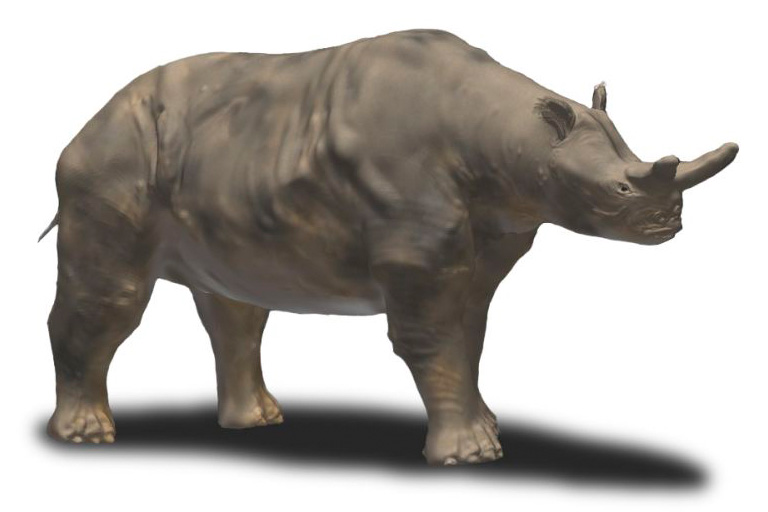
What I had here, folks, was a sizable chunk of a lower jaw of an animal called a titanothere (see below). Superficially, they look a bit like rhinos, and they are distantly related to them. They were found all over the western North American continent and Asia. I already had some titanothere material in my collection, but nothing from the skull before this piece. You know how I paid about fifty bucks for the fossil? I’ve seen similar pieces going for ten times that, condition notwithstanding. So, yeah, kind of accidentally ripped the seller off.
How did I know this? The teeth were a dead (pardon the expression) giveaway. Elephants have very distinctive teeth, with mastodon being pointed and nipple shaped (hence the name) and mammoth teeth being flatter and corrugated-looking, for lack of a better term. The teeth on this specimen didn’t match either of those descriptions, and a quick consult of one of my reference books pointed me in the right direction. Once I ruled out elephants, titanothere became my prime suspect based on size alone, but the book confirmation helped.
Here’s the second, bigger problem. A lot of titanothere material is found on Native American land, where collecting is illegal. I messaged the seller and asked where the fossil came from. If I got even the slightest hint that it was illegally obtained, it was going right back to the sender, or to the authorities. Turns out the seller didn’t know where it came from. It had been sitting up in an attic for decades. All he knew was that a relative acquired it sometime in the 1980’s or thereabouts. Based on the condition the fossil was in, I can buy that. Repeated exposure to temperature swings and moisture (commonly seen in attics) can play hell with fossil integrity. It took all of the stabilizer I had just to keep this thing in one piece. It’s not pretty and never will be, but at least it’s not crumbling anymore. It now lives with the rest of the titanothere fossils, but on a crochet cushion to prevent further deterioration.
Without knowing exactly where it is from, I can’t make an exact genus identification with one hundred percent confidence. If the piece is from the White River Formation, which I suspect it is, the best guess would be Megacerops. It would fit the size and location of the specimen, and that is the only titanothere found in that formation. Again, my identification hinges on where I think the specimen is from…if it’s from further west, that would change my thinking. Below is a picture of a typical titanothere.
Hilary
Leave a Reply