You tend to get posts like this one.
Yes, this does factor into the Melusine’s Endgame series. How? I guess you’ll have to read all the books when they come out!
Anyway…
Hemophilia is a righteously nasty disorder, and one that has always fascinated me. I taught about it every year during my Anatomy and Physiology class when we covered the blood unit. Fun fact…blood clotting is not a simple process. It’s actually a cascade of over a dozen chemicals in your blood, with one change activating another change, and all down the line until you form a clot. Here’s an image of what that cascade should look like in a normal person:
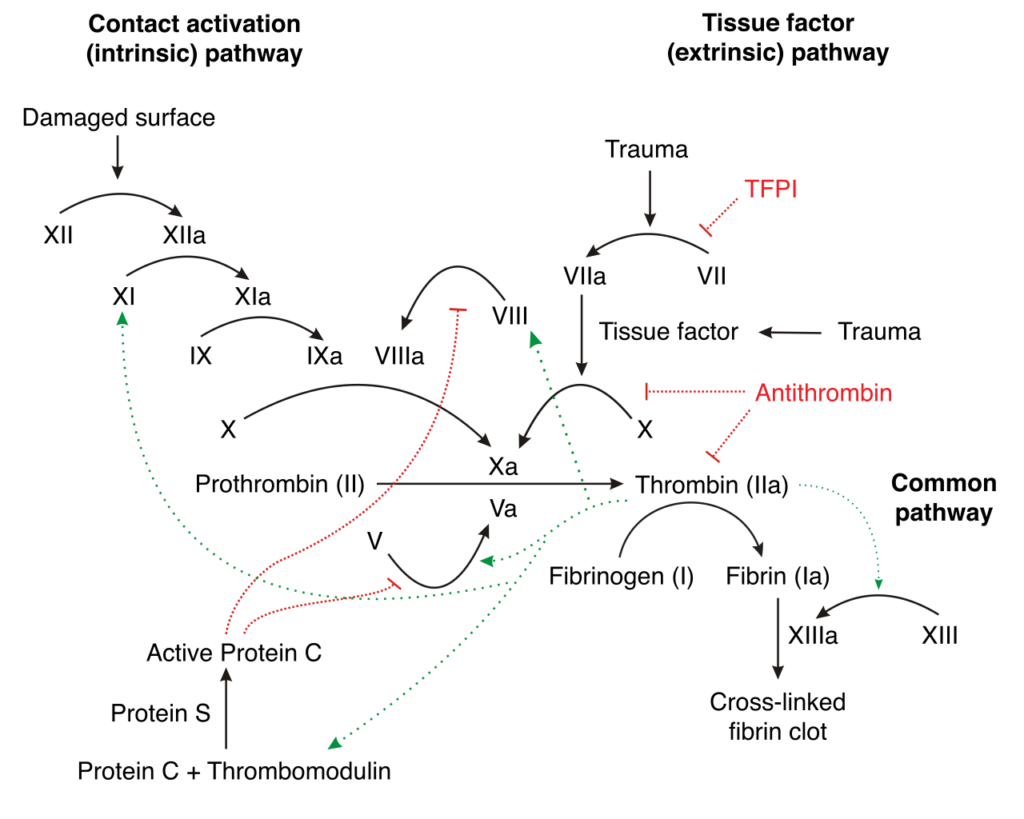
Yeah…all that to form a blood clot.
With hemophilia, one or more of the factors is compromised, and doesn’t work as it should. With a cascade series, anything early on in the series affects everything after it. Picture it like a domino effect. If you remove one domino in the pathway, it might lead to the ones after it not falling. That’s kind of how hemophilia and other clotting disorders work.
Calling hemophilia unpleasant is the kindest way to refer to its effects. People with the disorder bleed excessively from cuts, bruise very easily, and often experience excruciating joint pain. Until effective treatments became available, many hemophiliac males died young. Head trauma was particularly dangerous, since it could very easily trigger a catastrophic bleed in the brain. Generally speaking, internal bleeding was more dangerous, as it was less visible and might go unnoticed until it was too late to do anything.
The hemophilia type I’m most interested in is Hemophilia B, which is the type that afflicted Queen Victoria and a fair number of her descendants. This version of hemophilia has a mutated F9 gene, which codes for Factor IX in the clotting cascade. This factor is toward the upper left side of the diagram.
This genetic disorder is X-linked, meaning it is carried on the X chromosome. What this means from an inheritance standpoint is that males are more likely to have the full-blown disorder, while females are more likely to be carriers (meaning, they might not exhibit full symptoms, but can pass the trait to their offspring).
Why is this?
Males have only one X chromosome, wheras females have two. So, if a male inherits the faulty gene from mother, he will have full on hemophilia, since he does not have another, normal X chromosome to balance out the mutation. There is no such thing as a carrier male unless they have an extra X chromosome kicking around, like Klinefelter syndrome. Females, having two X chromosomes, are less likely to have the disorder to its full extent (though, if they are born from a carrier mother and a hemophiliac father, they can have the full version of the disorder). It happens, but it’s not common. Below is a pedigree for Queen Victoria and her descendants.
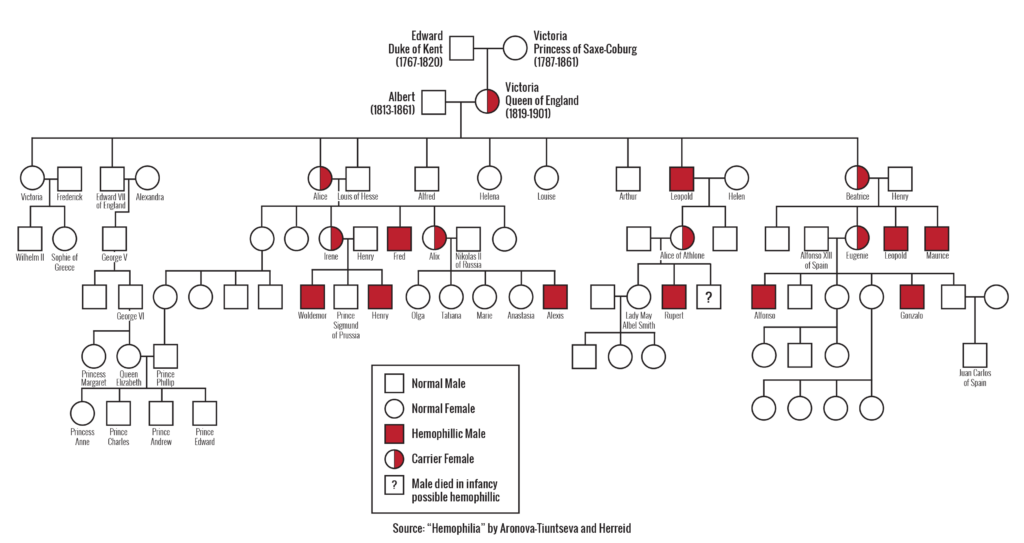
Complex, I know. With X-linked recessive disorders like Hemophilia B, statistically speaking, half of a carrier female’s daughters will also be carriers for the disease, and half of her sons will have the full version. In this case, one out of four of Victoria’s sons (Leopold) had hemophilia, whereas the other three (Edward, Arthur, and Alfred) did not. So, Victoria actually got lucky with that ratio.
Her daughters show a more typical breakdown, with Alice and Beatrice being known carriers, and Victoria and Helena not carriers. Louise is a bit of a question mark, as she did not have children, so I’m not sure if she was a carrier or not (and to my knowledge, her remains have not been tested for the trait). Still, the daughters do have a roughly fifty-fifty split of carrier versus non-carrier.
The daughter I want to zero in on is Alice, who would marry into one of the German royal families. She in turn was the mother of Alix of Hesse, who would later become Tsarina Alexandra of Russia. Alice’s pattern is a little harder to discern than her mother’s. Two of her daughters (Alix and Irene) were carriers, where Victoria was not. The two other daughters, Elizabeth and Marie, are unknown. Elizabeth had no children, and Marie died very young during the same diptheria outbreak that also killed her mother, Alice.
Alix (Alexandra) went on to have five children of her own: Olga, Tatiana, Maria, Anastasia, and Alexei. Alexei did have the full disease, and this could easily be a considered the reason for the fall of the Romanov dynasty (though personally, I think of it more as the straw that broke the camel). As none of her daughters had children, it’s not certain which ones would have been carriers.
However, primary sources from the time do note that all four daughters suffered from very heavy menstrual periods and seemed to bleed more than normal. These are symptoms of a carrier for hemophilia. Also, the third daughter, Maria, hemorrhaged during a minor surgery. This is also a red flag for a carrier. Based on these facts, I can pretty comfortably say that Maria was almost certainly a Hemophilia B carrier, and it would not be surprising to me if her other sisters were as well.
So, where did this disease come from? Notice on the pedigree that the first person who was a confirmed carrier was Victoria herself. In fact, when her son Leopold was confirmed as having the disorder, she said something along the lines of ‘that is not a disease of my family.’ And up until that point, she was entirely correct.
There’s two possibilities as to where the mutation arose. The first is that it was a spontaneous mutation that came from Victoria herself. Given how many children she had and the predilection for royal families intermarrying, she was about the worst possible person to have a mutation like this crop up. For a decades, this was considered the most likely scenario.
Modern genetics, however, shed a bit more light onto what might have happened. The hemophilia mutation becomes increasingly common when fathers are of advanced age when they sire children. Victoria’s father, the Duke of Kent, was in his mid-fifties when Victoria was born. This is right about the age where that mutation becomes more prevalent.
The question is: where did the mutation arise?
We may never know for sure. The easiest way to tell would be if Victoria had and siblings, particularly sisters. If the sisters proved to be carriers, than that would point to the Duke of Kent being the originator of the mutation. However, Victoria was an only child, so comparison is impossible. Based on modern science, I am more inclined to think that the Duke of Kent was the originator. Victoria’s mother was not a carrier, and the disorder had never been documented in her family.